
No one radiant heating system is ideal for all situations, but after 40+ years of serving customers, a few systems and techniques stand out. We like simple honest value, with no gimmicks or do-dads. The best systems should be reliable, long lasting, and easy to work on. They should be energy efficient and environmentally responsible and they must be affordable. The best radiant systems should offer the features at right.
Check out our video below to learn more about the best radiant heating system.
The Best Systems Should Offer:
- Low initial cost
- Low operating cost
- Environmental sensitivity
- Energy efficiency
- Simple and easy to work on
- Compatibility with solar energy
- Should be “DIY friendly”
The Best Overall Heating System Is Here
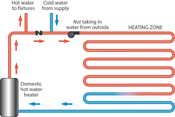
Simplified Schematic of The Open Direct System
The best radiant systems will use a high quality, high efficiency water heater instead of a boiler. These systems cost about half as much as one using a typical boiler. Yet, they are much more efficient. They are a simple, ingenious way to make warm water for radiant space heat, and domestic hot water, and you actually get a little cooling when you want it. If you use a boiler, you will incur extra costs and miss out on some great opportunities.
Domestic hot water based radiant heating systems are affordable. They make the exceptional comfort, high efficiency, and health benefits of a radiant heating system available to everyone. Not just the one percent!

Photograph of the Open Direct System
You can use the same water heater for your radiant heating system that you use for domestic hot water!
There are two systems to choose from that provide domestic hot water and space heating from the same unit. One is the indirect system that uses a heat exchanger and the other is the direct system that does not.
The “Open Direct System” is a significant breakthrough in radiant heating design. The Open Direct Radiant System offers unprecedented efficiency with a highly affordable first cost and is our preferred system of all radiant heating systems. It is one single system that operates in two different and distinct ways. When floor heat is called for, the pump comes on and water flows out of the tank, through the radiant floor heating zone and back to the tank. When domestic hot water is wanted, water flows out of the tank and goes to the fixture. All water in the system remains potable.
It is arguably the most energy efficient and environmentally friendly heating system in the world.
It is one of the very few exceptions to the rule that better things cost more. You are literally getting a much better system for a lot less money.
Open Direct System Energy Efficiency Benefits:
- The “Open Direct System” uses radiant heating which is fundamentally more energy efficient.
- Dual use designs have less than ½ the standby losses of two independent methods. One set eliminated and the other reduced because of efficient utilization.
- Lower first cost presents the opportunity to buy a better, more efficient unit.
- The “Open Direct System” is compatible with solar.
- Domestic water heaters are potentially more efficient than a boiler. They can operate at low temperatures and they enable condensation of the flue gasses. Be aware that these benefits are only available with quality water heaters and may not be realized with cheap models.
- Cold water pre-heat provides limited free cooling by the detail where cold replacement water passes through the tubes in the floor before it goes to the tank.
- The tank enables a huge heat exchanger for the flue which enhances efficiency.
Open Direct System Environmental Benefits:
- Lower fuel consumption
- IF YOU CONDENSE THE STEAM IN THE EXHAUST DOWN TO WATER, YOU CAN PICK UP ANOTHER 10% IN EFFICIENCY. Significant amounts of the pollutants will dissolve in the water and they go harmlessly down the drain instead of polluting the air.
Click here for more information about radiant systems that use the domestic hot water heater as the heat source.
The Direct System
(shown here in heating mode operation, one of three possible modes)
Click here for detailed information

These radiant heating systems are arguably the
best and most efficient heating systems available.
Heating systems utilizing a water heater cost about half as much as those using a typical boiler. Yet, they are much more efficient. They are generally made of better materials. They are a simple, ingenious way to make radiant space heat and domestic hot water within the same unit. Properly designed domestic hot water based systems meet all major codes and are exceptionally safe. Because these systems operate at low temps they are more energy efficient and safer than systems using a boiler. Since the expense of a boiler is entirely eliminated, these systems are more affordable as well. Domestic hot water heater based heating systems are even compatible with a solar energy assist.
These systems are sometimes labeled “controversial” by people in the heating industry that want to sell you an old-school boiler system that costs 2 to 3 times as much. We have the science and happy customer feedback to back up our hydronic systems. It is up to you to consider the source of any negative comments.
The Best Heating Unit
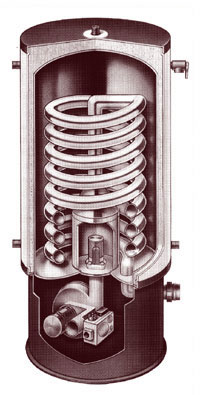
The Polaris Water Heater.
Note the giant stainless steel
exhaust flue for extra efficiency.
The Polaris heating unit is a water heater (not a boiler) engineered for space heating and domestic hot water production. Because it is designed to make water warm instead of very hot, it is incredibly efficient – and safer as well. The Polaris is all stainless steel. A huge submerged stainless steel flue extracts just about every possible BTU of heat from the flue gas. Standby losses are nearly eliminated.
Even with these benefits, the Polaris costs far less than a similar capacity boiler. It’s a good value to buy, and a good value to continue to operate over time.
Click here for more information about the Polaris.
The Best Radiant Tubing
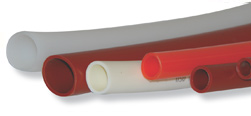
The least desirable place to cut cost is with radiant tubing and fittings. Radiant tubing often goes into inaccessible places where it would be difficult to replace. Is the material approved? Can you work with it? Is it energy efficient? Do not use waterline that has been retasked as radiant heating pipe. It is not worth it.
Here are some of the benefits to proper tubing selection:
- Higher heat output
- Less pumping cost
- Longer circuits possible
- Lower, safer operating temperatures
- More energy efficient
- Longer service life
- Lower electric bills
- Quieter operation
- Compatibility with solar heating and alternative energy.
Click here to learn more about high efficiency radiant heating tubes.
The Best Detail for a Joisted Floor

Photograph of a Joisted Floor System “Staple-Up”
Many joist installed systems on the market do not work very well, or cost too much. The following details are very important for performance and cost.
We suggest that you heat the floor with tubing installed in the underfloor joist spaces beneath the sub floor. Use 5/8″ PEX with .070 wall thickness. Use high efficiency tubing. Space the tubing 8″ apart within a 16″ joist space. Use thinner gauge aluminum heat emission plates and use them everywhere if possible.
The 5/8″ tubing is larger than typical 1/2″ material. It puts out more heat and allows the system to operate with lower fluid temperatures for longer life and better efficiency. The larger size reduces pump work and allows longer circuits. Tubing that is larger than 5/8″ may be too difficult to work with.
The aluminum plate takes heat away from the tubing and distributes it throughout the sub floor. Research shows that this detail is very important. The plates support the tubing well and the improved heat transfer is significant. Thinner aluminum plates have equivalent performance as thicker plates with half the cost.

Comparison of radiant tubing effect with and without aluminum heat plates.
The aluminum material has a very important and often overlooked property. Aluminum radiates much less heat into the air than other materials. This property sharply reduces heat loss in the downward direction (back loss) and has the effect of insulation. It is very important to control heat loss in the wrong direction. These losses can nullify most of the benefits of radiant heat.
Click here to read our research report about aluminum heat emissions and heating performance.
The thermograph on the right shows a significant difference in floor temp when aluminum plates are used. The far (orange/yellow) side of the floor has tubing and continuous plate coverage, while rest of the floor has tubing without plates. You can see from the legend in the right of the photo that this represents a large difference in temperature.

Thermograph of operating aluminum plates
The thermograph (right) shows that the plates (blue) emit much less heat than the surrounding areas (red, orange) even though they are at a much higher temperature. This means that the plates are taking the heat away from the tubing, distributing it through the floor, and then, making the heat go in the right direction.
Feel free to contact customer service technicians if you would like more information about these details. Customers may also request a research report.
The Best Details for Slab on Grade Construction
Insulation Details
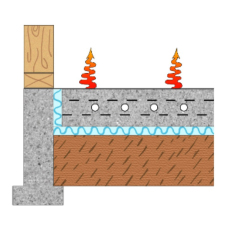
Schematic showing Slab on Grade
Our research shows that under slab insulation is most important at the perimeter and less important in the center of the building. Insulation should be extruded polystyrene. We know of no other acceptable material. In cold climates, it should be 2 inches thick at the perimeter. It may taper off to 1 inch as it goes inward towards the center of the building. Insulation should extend 12 feet from the perimeter towards the center of the building in cold climates. It can be reduced to 6 feet in warmer climates. Our experience indicates that failure to insulate properly is one of the most serious mistake that you can make.
Concrete reinforcement
“Rod” type reinforcement (rebar) is preferred over the “mesh” type because of overall strength and workability. Put down half of the rebar first and set it on “chairs.” Then lay out the tubing. Lay out the other half of the rebar on top of the tubing and tie everything together. It will be easier to lay out the tubing and the tubing will be well protected. The rebar will carry heat away from the tubing. It is generally well placed with half above the centerline of the slab and the other half placed a little beneath. Fiberglass reinforcing fibers are not a substitute for steel reinforcing.
Tubing Size and Spacing
If the slab is to be of any significant size, (1000 square ft or larger), a larger diameter tubing is preferred. Up to 7/8″ diameter. A larger tube (within reason) will put out more heat, reduce pump work and enable longer circuit lengths. Tube spacing may be spaced 24″ on center in very efficient and stable environments (such as basements). A 16″ spacing is more typical for reasonably efficient residential construction. A 12″ spacing will provide a little more heat and a more rapid response time.
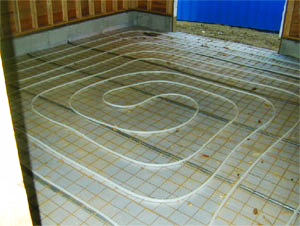
Tubing layout should be a spiral or have gentle turns by another design.
Detailed research (DOE) has shown that 7/8″ PEX tubing with 0.70″ wall thickness and a circuit length of 200 feet is about ideal. The electrical consumption of the pumps will be as low as possible and the flow will be just slightly turbulent. The temperature drop will be about 10 degrees F from inlet to outlet. This is ideal, but different designs can still produce satisfactory results.
Tubing layout should be a spiral or have gentle turns by another design. Very tight turns strain the material and raise pumping costs. There is no benefit to a very tight and very evenly spaced design.
Click here to learn more about the benefits of an engineered tubing.
The Best Solar Heating System
If you start out with a water heater based heating system then it is easy to add a solar supplement. Now or in the future. Solar domestic water heaters are well proven and accepted.
The “Solar Option Two” heating system is an extension of successful solar domestic hot water applications. In the right place, the solar domestic water heaters have been successful. The work must be done right and the domestic hot water production is valued. Schools and churches are often not appropriate, while residential construction is often ideal.
The radiant heating system is designed to use the domestic water heater as the energy source. Additional solar panels are provided so that some contribution to space heating or other energy needs can be made. The overall system may be limited by the ability of the house and system to store heat.
This system, either as a solar “assist” or in a building that already has its own “thermal mass” is cost effective in all areas of the United States when it is planned thoughtfully.
Click here to visit our solar heating website
The Best Pumping Design
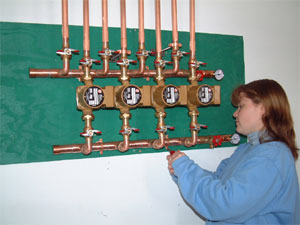
Every month of the heating season, you must pay for the energy that your pumps use. It is most efficient to use a single individual pump for each heating zone.
The alternative would be to use one large pump and individual zone control valves. This is a common practice, but it is not good design. The pump must be sized so it can provide adequate flow when all of the zones are calling for heat. Most of the time, however, only one or two heating zones are calling. The pump is too large for the task resulting in a waste of electricity and unnecessary wear on the system.
A zone valve costs nearly as much as a small pump so there is really no money to be saved by using them.
We provide adjustable three speed pumps. These pumps will be set to meet your needs with the lowest amount of electrical use possible.